
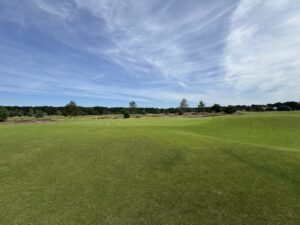
 The greenkeepers of Bernardus Golf have meticulously prepared a perfect playing golf course for the Solheim Cup, and broadcasters, TV viewers around the world and the LPGA Tour itself are guaranteed the stunning visuals that have become the norm. Despite a record-breaking dry summer, Niall Richardson and his team have fine-tuned water management on the golf course to a T. A carefully selected surfactant made the difference.
Like the weather predictions for Bernardus Golf in Cromvoirt, the Netherlands, the condition of the grass currently looks brilliant for hosting the prestigious Solheim Cup of the Ladies Professional Golf Association (LPGA). Recent seasons have been anything but predictable. “We have certainly seen a change in the weather pattern over recent years,” says head greenkeeper Niall Richardson of Bernardus Golf. “2023 and 2024 were very wet years, whereas 2025 was drier. At this moment, 2026 is our driest year on record so far.”
The development has made Bernardus Golf one of the most water-conscious golf courses in the country, if not on the continent. Richardson explains: “That contrast really demonstrates why you cannot manage a golf course based on what happened last year. We have to build a system that can cope with both extremes. You want to retain moisture when needed and increase the infiltration or penetration during prolonged wet periods.” This explains why Bernardus Golf has made precision water management an art. “Our objective is not to irrigate more, despite an increase in demand. It is to make every cubic metre of water work as effectively as possible.” It is a focus that was alien to the Irishman before he moved to the Netherlands. “When I moved to the Netherlands in 2008 to grow-in a championship golf course, I quickly became aware of the difference a few degrees higher had on turf and longer drier periods. At that point, we were looking for ways to improve our water management, and, particularly, to retain moisture when needed and increase infiltration or penetration during prolonged wet periods.”
The soil-first approach that Richardson and his team pursue makes combating hydrophobicity, whereby an acid coating covers particles, thus making them water repellent, an essential aspect of his work. “We aim to grow a healthy, resilient plant that can use water efficiently. Good water management is not about keeping everything wet. It is about understanding what is happening underneath the surface and making decisions that improve the plant and the soil in the long term. That means good soil structure, air and water movement, appropriate moisture levels, healthy roots, balanced nutrition and the right grass species for the environment. That is why we focus on how effectively the soil is accepting, distributing and retaining that water.”
Traditional surfactants mask hydrophobicity symptoms by altering the surface of the particle while leaving the organic acid coating that covers the particle untouched. As a result, the water interacts primarily with the surfactant rather than directly with the (soil) particle. To counter this, Bernardus Golf selected a type of product Richardson had been working with since he arrived in the country in 2008. “The surfactants we have advised Niall target the organic acid coating on the particle. Once these organic acids are released from the particle, the interaction with the water, the so-called hydrophilicity, is gradually restored,” Christiaan Arends of Aqua Aid explains. “With every treatment water moves more freely, deeper, more consistently and more uniformly back into a rootzone. The final result is that the rootzone will work the way it should.”
To Richardson, the effectiveness of the Aqua Aid surfactants is clear. “We combine soil moisture readings, weather data and evapotranspiration figures with irrigation-system data and regular assessments of infiltration and drainage. There is no single number that tells you everything. We combine the data with what we see in the field.” Each application gradually dissolved the water-repellent coating. “It only takes two applications to dissolve 27% of the water-repellent coating,” Arends explains.
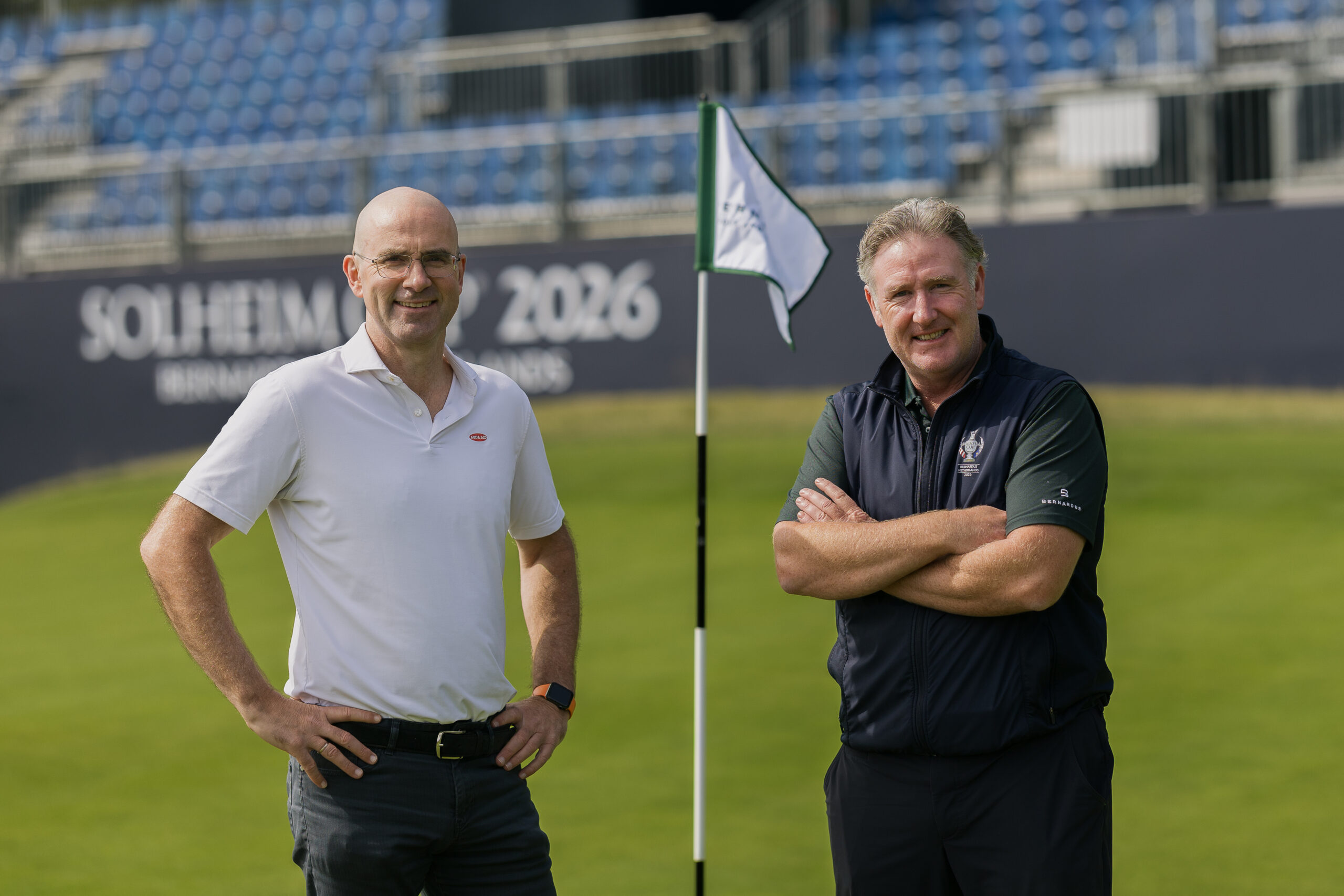
The course for the Solheim Cup has been prepared with a combination of a soil-penetrating surfactant and a multi-branched long-term surfactant. Both products dissolve completely and don’t leave any residue. “They are completely compliant with the EU legislation for biodegradability, which is why they can also safely be used in sensitive environmental areas,” Arends continues. “The organic acid redistribution system (OARS PS) removes organic acids that cause hydrophobicity and returns the soil to its original state. The heavier molecular weight improves soil integration. It lasts approximately 40% longer than conventional wetting agents and requires fewer applications to still be effective.” The final result is a high-quality, firm, dry and fast playing surface that is less prone to disease.
The multi-branched long-term surfactant (3D Technology) in PBS150 improves soil integration, which results in a reduced need for irrigation as it has excellent re-wetting capabilities on hydrophobic soils. “It has a consistent and reliable performance for up to 150 days and outperforms conventional surfactants by 40%.” Using the multi-branched long-term surfactant yields savings in time, labour and money as well as being a boost for sustainable turf management. “Both products benefit from the patented 3D Technology that focuses on water retention in the soil, at the right depth and reaching every spot.” As the surfactants are available in granular and liquid form, the greenkeepers at Bernardus Golf can control the water management on the golf course precisely.
For Richardson, the tournament carries weight beyond the agronomy. “Bernardus Golf only opened in 2018, so to have reached the point where we are hosting one of the biggest events in women’s golf in such a relatively short period is something everyone here can be extremely proud of,” he says. The use of a surfactant has played a significant role. “Do not just learn which product to apply; learn why you are applying it and what you are trying to achieve. We use Aqua Aid products primarily as part of our water-management programme, with the greatest focus on the areas where moisture consistency is most critical. That includes the greens and surrounding playing surfaces, with applications adapted according to the requirements of the different areas of the course. We don’t treat the entire course identically because the soil, grass species, traffic and water requirements vary significantly.” This explains why the fairways have a specific programme utilising PBS150. “Our programmes are based on need rather than simply applying the same product at the same rate everywhere.”
For Richardson, patience is what separates good maintenance from excellent maintenance: “You cannot build a great golf course overnight. The best results come from making good decisions consistently over many years.” The tailored approach explains why the products are so effective. “Like the game itself, it is all a matter of selecting the right tools to achieve the maximum result with the minimum input,” Arends states. Being familiar with the product for close to 20 years, Richardson is pleased that this can now serve him well during a prestigious international tournament. “A major event gives you an opportunity to accelerate improvements that might otherwise take several years. The infrastructure, knowledge and experience we gain will remain with the course, and with the team.” The final result will be visible at Bernardus Golf from 7 to 13 September.