
A collaborative trial by DETAILS, Servicentre, Aqua Aid Europe, SmartCourse, and Denodl at Monte Rei and Laguna Vilamoura demonstrates the real-world potential of 3D wetting agent technology combined with precision monitoring.
The Challenge: Doing More with Less
Water scarcity is one of the defining challenges of modern turf management. Across Southern Europe, golf courses face mounting pressure to reduce consumption while maintaining the playing surface quality that members and visitors expect. For course managers, the question is no longer whether to save water, but rather how, without compromising turf health.
Monte Rei in the Eastern Algarve and Laguna Vilamoura are two of thirteen Portuguese golf courses managed by DETAILS, who have placed sustainability and efficient water management at the heart of their operations. Their latest initiative: testing the use of 3D technology wetting agents to increase turf moisture absorption, thereby enabling a measurable reduction in irrigation.
The Approach: Science, Technology, and Partnership
DETAILS selected two of its flagship courses for the trial, Monte Rei in the Eastern Algarve and Laguna in Vilamoura, and brought together four specialist partners, each contributing a distinct capability.
Servicentre, as Aqua Aid Europe’s distributor for the Iberian Peninsula, played a key role in initiating this trial alongside DETAILS and also provided agronomic advice.
Aqua Aid Europe supplied PBS150, a patented, biodegradable 3D multi-branched long-term surfactant with a consistent and reliable performance for up to 150 days. The heavier molecular weight and 3D technology improve soil integration, which greatly reduces irrigation needs. The long-lasting effect of PBS150 outperforms conventional surfactants by 40% and reduces the number of applications. PBS150 has excellent re-wetting capabilities on hydrophobic soils and withstands the toughest drought and heat conditions. Under standard conditions, it reduces water use by up to 35% and irrigation cycles by up to 70%, saving time, labour, water, and money while supporting sustainable turf management.
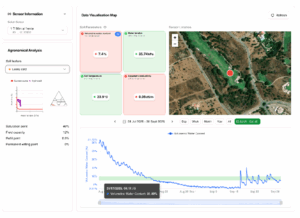
SmartCourse™ monitored the product’s effectiveness on turf health through above-ground NDVI readings taken at regular intervals using drones, combined with continuous satellite-based NDVI data. Greenkeepers also entered key information into the SmartCourse™ platform, including irrigation metrics, moisture readings, maintenance updates, and regular field observations.
Denodl installed several HYDROBALL™ sensors across both test and control areas to continuously measure real-time water tension and volumetric water content. This provided greenkeepers with immediate insight into the turf’s response to both the product and irrigation practices.
Together, this combination of product performance, precision monitoring, and agronomic data created a robust framework for evaluating irrigation reduction under real-world conditions.
The Results: Measurable Impact
The trial delivered clear and encouraging results across both courses.
Drone-based NDVI readings revealed a strong trend toward health stability in the treated areas. Turf quality remained consistent even as irrigation volumes were reduced; a clear indication that PBS150 was helping the soil retain and distribute moisture more effectively.
Drying curves generated from HYDROBALL™ measurements in the treated zones showed a slower and more stable decline in soil moisture. This extended the “safe window” between irrigation cycles and reduced the risk of reaching turf stress thresholds, giving greenkeepers more confidence and control over their irrigation scheduling.
Perhaps most valuable, the trial also revealed the exact point at which irrigation reduction starts to negatively impact turf health, even when wetting agents are applied. This precision insight gave the greenkeepers the ability to fine-tune their irrigation strategy with a level of accuracy that was previously unavailable.
The Bottom Line: up to 20% Water Savings — and Room to Grow
Overall, the trial demonstrated that PBS150 can help reduce irrigation by up to 20% under real-world conditions. A significant result, especially considering that product applications were carried out later than recommended by Aqua Aid. The findings concluded that an even greater irrigation reduction is potentially achievable through earlier product application and close monitoring using NDVI and real-time root-zone technologies. With PBS150’s proven capability to reduce water use by up to 35%, the room for further optimisation is substantial.
For DETAILS and the courses they manage, the implications are clear: lower water consumption, reduced operational costs, and a more sustainable approach to turf management. All without sacrificing the quality of the playing surface.
Guarding the Green, Together
This trial is a compelling example of what becomes possible when innovation, technology, and collaboration come together. By combining Aqua Aid’s patented 3D surfactant technology with SmartCourse’s precision monitoring and Denodl’s real-time soil monitoring, DETAILS has taken a data-driven step toward more sustainable golf course management.
At Aqua Aid Europe, we believe that effective water management starts with science and ends with results. PBS150 is part of our 3D Technology range; patented, scientifically researched, and proven. A biodegradable addition of longer and multi-branched molecules to your growing media. While the technology may sound complex, its application is remarkably simple and fits every budget.
The soil retains water longer, at the right depth, and the water reaches every spot. For a safe and sound surface. That’s how we guard a green future — together.
OUR SURFACTANTS WITH
3D TECHNOLOGY
OARS HS
Soil hydrating surfactant
Soil penetrating surfactant
Long-term soil hydrating surfactant
Infiltrating – hydrating surfactant

